Electrical technician training in Brownsville, Texas, can introduce beginners to the principles and practical skills involved in electrical systems. Students may learn about wiring, circuits, motors, controls, lighting, distribution panels, grounding, commercial applications, testing, and troubleshooting. Because electrical work combines mathematics, technical knowledge, tools, and detailed procedures, a training program should provide both classroom instruction and supervised hands-on practice.
Southern Careers Institute offers an Electrical Technician diploma program at its Brownsville campus. Students are not expected to begin the program already knowing how to wire a circuit or diagnose an electrical problem. The curriculum starts with safety and basic construction concepts before moving into electrical theory and increasingly complex applications. Understanding how the courses progress can help beginners decide whether the program matches their interests and preferred learning style.
Starting with Safety and Electrical Fundamentals
The program begins with Trade Safety and Construction Basics. Students learn about workplace awareness, construction mathematics, measurements, tools, communication, and procedures for working around construction materials and equipment. Personal protective equipment and safe work habits are introduced early because electrical training requires students to pay close attention to their environment.
Safety is not limited to the first course. It remains part of every laboratory activity. Before beginning a project, students may need to inspect the workspace, review instructions, select tools, identify possible concerns, and confirm that the equipment is prepared correctly. Learning to slow down and check each step can be more important than completing an exercise quickly.
Students then move into Electrical Theory and Concepts of Wiring. This part of the program introduces the principles used to understand circuits and electrical systems. A beginner may initially see wiring as a collection of individual connections, but electrical theory helps explain how current, voltage, resistance, and system components relate to one another.
Mathematics supports this understanding. Students should expect to complete calculations, interpret measurements, and apply formulas to electrical problems. Someone who has not used mathematics recently may need additional review, but the goal is to connect the calculations with practical applications rather than study numbers without context.
The curriculum progresses into direct-current and alternating-current motors, control systems, maintenance, and troubleshooting. Motors and controls appear in many electrical andmechanical systems, so students need to understand how equipment is operated and how components work together. They also begin learning how to approach a system that does not function as expected.
Moving into Wiring, Distribution, and Controls
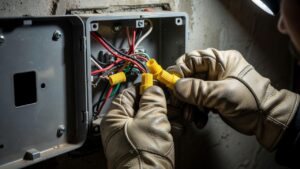
Residential Wiring, Grounding and Bonding gives students opportunities to explore common wiring methods and the systems used to support electrical safety. Grounding and bonding are not simply additional wires added at the end of a project. They are part of how electrical systems are designed and installed, so students need to understand their purpose as well as the practical steps involved.
Conductors and Electrical Distribution expands the focus to the movement of power through electrical systems. Students study conductors, distribution equipment, and panels while applying earlier lessons in electrical theory and mathematics. They begin seeing how individual circuits fit into a larger system.
Later courses address lighting systems and programmable controllers. Lighting involves more than connecting a fixture. Students may need to understand circuits, controls, components, and the relationship between a lighting system and the source of electrical power. Programmable controllers introduce another type of control system and show how electrical equipment can be managed through organized instructions.
The program also includes Electrical Components and Equipment, Electrical Calculations and Commercial Wiring, and a course focused on electrical applications and specialized installations. These subjects help students move beyond introductory residential concepts and consider the equipment, calculations, diagrams, and procedures associated with other environments.
Each course builds on previous material. A student who understands electrical theory can apply that knowledge when working with a motor. Experience reading wiring diagrams can support later commercial projects. Lessons in grounding, conductors, and distribution remain relevant when students begin working with panels or specialized equipment.
Beginners should not expect to master every subject immediately. Electrical systems can appear complicated because several components and concepts may be involved at once. Consistent attendance, regular review, and a willingness to ask questions can make the progression more manageable.
Learning Through Hands-On Electrical Projects
SCI’s Electrical Technician diploma program includes 720 clock hours and 49 quarter credits. The curriculum is divided into 270 theory hours and 450 laboratory hours, giving students substantial time for practical application. The catalog lists an estimated completion time of 27weeks, although current schedules and start dates should be confirmed with the Brownsville campus.
Laboratory activities allow students to work with electrical equipment, wiring, motors, controls, distribution panels, lighting systems, and simulated construction situations. Instead of only looking at a diagram, students can follow it while completing a project. Instead of only reading about a meter, they can learn how measurements are taken and interpreted.
Hands-on projects also allow instructors to evaluate the student’s process. An electrical exercise may not work correctly on the first attempt. A connection could be incorrect, a diagram may have been misunderstood, or a measurement may not match the expected result. Students learn to review the system methodically rather than making random changes.
Troubleshooting begins with understanding how a system should operate. Students can then gather information, test appropriate points, compare findings with the expected conditions, and narrow down possible causes. Instructors may ask students to explain why they selected a test or what a measurement indicates. This helps connect physical actions with technical reasoning.
Laboratory work also develops organization and communication. Students need to manage tools, wiring, components, and instructions carefully. They may share equipment and work near classmates completing other exercises. Maintaining an orderly space, communicating clearly, and following laboratory rules can support both learning and safety.
SCI identifies the program with traditional and hybrid delivery. Some theory instruction may be available online, but hands-on activities require students to attend the Brownsville campus. Online portions still include assignments, attendance expectations, and deadlines. Students need dependable internet access, an appropriate computer, a webcam, a microphone, and required software.
Preparing to Attend SCI in Brownsville
SCI’s Brownsville campus is located at 935 North Expressway. A campus tour can help prospective students see the electrical laboratory and ask how the theory and practical portions of the program are arranged. It can also provide a clearer idea of the tools, mock-ups, panels, motors, and other equipment students may use.
Before enrolling, ask about current class schedules, the balance between online and in-person instruction, attendance policies, and the amount of study expected outside class. Beginners may also want to ask what academic support is available for mathematics, electrical theory, diagrams, and troubleshooting.
The Electrical Technician program requires a criminal-history and employability background check. SCI also strongly recommends that students have a valid state-issued driver’s license because employers may require one. Prospective students should review these requirements directly with an admissions representative.The catalog lists an Electrical Technician tool kit as a separate out-of-pocket expense. Students should ask what the current kit includes, when it is required, and whether they need additional protective clothing or equipment. Financial aid may be available to those who qualify.
SCI’s Career Services may provide résumé assistance, interview preparation, and job-search guidance. These services support students as they prepare to pursue opportunities, but completing the program does not guarantee employment or a particular position.
Electrical technician training in Brownsville, Texas, may fit beginners who enjoy practical problem-solving and want to understand how detailed systems operate. SCI’s program introduces electrical theory, safety, residential and commercial wiring, motors, controls, grounding, distribution, lighting, calculations, and troubleshooting. Contact Southern Careers Institute to tour the Brownsville campus and explore whether the Electrical Technician diploma program matches the skills you want to begin building.