
Choosing a skilled-trades program can be difficult when several paths offer practical learning and career-focused instruction. Welding, HVAC, Electrical Technician, and CDL-A programs all involve hands-on training, but they prepare students for different responsibilities and work environments.
A student who enjoys working with metal may not enjoy diagnosing a cooling system. Someone interested in wiring and circuits may not want to spend the day operating a commercial vehicle. The right training program should match the student’s interests, abilities, schedule, and preferred approach to solving problems.
Southern Careers Institute offers these four programs at selected campuses across Texas. Comparing the curriculum and daily learning experience can help students decide which option fits them best.
Begin with the Kind of Work You Want to Learn
Start by thinking about the materials, systems, or equipment that hold your attention. Welding training centers on metal. Students practice preparing materials, setting up equipment, cutting, brazing, soldering, and completing welds using several processes. They learn how position, movement, settings, and material preparation influence the finished result.
This path may appeal to someone who likes building or repairing physical objects and wants to see the result of each attempt. Welding also requires patience because improvement often comes through repeating the same type of work after receiving feedback.
HVAC training focuses on heating, cooling, airflow, ventilation, refrigeration, electrical components, and mechanical equipment. Students learn how different parts work together within a complete system.
This program may suit someone who enjoys investigating why something is not operating correctly. HVAC troubleshooting often begins with a symptom and requires the student to check several possible causes. The answer may involve airflow, controls, pressure, electricity, refrigerants, or equipment condition.
Electrical Technician training focuses more directly on circuits and electrical systems. Students study theory, wiring, motors, controls, grounding, distribution, lighting, programmable controllers, commercial applications, and troubleshooting.
This path may fit someone who enjoys diagrams, calculations, detailed connections, and systems that must operate according to a specific plan. Electrical students need to work carefully because a small error can affect the entire circuit or project.
CDL-A training focuses on commercial transportation. Students study vehicle systems, inspections, safety, reporting, backing, shifting, road operation, speed management, and space management before practicing with a tractor and trailer.
Commercial driving training may appeal to someone who wants to work with large vehicles and can remain alert while managing changing road conditions. Students need to be comfortable accepting direct feedback and repeating maneuvers until they become more consistent.
Compare the Program Length and Learning Format
Program length can be an important factor, but students should not assume that the shortest program is automatically the best choice.
SCI’s Welding program includes 700 clock hours and has an estimated completion time of 27 weeks. Because 540 of those hours are laboratory hours, students spend much of the program developing practical skills in the welding shop.
The Electrical Technician program is also estimated at 27 weeks. It includes 720 clock hours, with 450 laboratory hours and 270 theory hours. The program combines hands-on electrical projects with calculations, diagrams, and technical concepts.
The HVAC program is estimated at 36 weeks and includes 942 clock hours. Its larger theory component reflects the number of connected subjects students study, including electricity, refrigeration, airflow, ducting, hydronics, commercial systems, controls, diagnostics, and design.
CDL-A training includes 160 clock hours and can take an estimated eight to 24 weeks. The range depends on the available schedule and the student’s progression. Theory is combined with 102 hours of practical range and road training.
Students should compare not only total weeks but also how those weeks are scheduled. Ask whether morning, afternoon, or evening options are available and how many days per week students attend.
Traditional programs complete instructional hours on campus. Hybrid programs make part of the theory instruction available online, but students must still attend in person for laboratories, shops, and driving practice.
Online theory can reduce some commuting, but it also requires dependable technology and self-discipline. Students need to complete assigned lessons without treating online coursework as optional. They should know how attendance is recorded, when assignments are due, and how theory connects with the practical portion.
Review Requirements, Costs, and Campus Availability
The right program must also be realistically accessible. Students should confirm that the program is offered at a campus they can reach consistently.
SCI offers Welding in Austin, Corpus Christi, Harlingen, Pharr, and San Antonio North. HVAC is offered in Austin, Harlingen, San Antonio North, and Waco. Electrical Technician training is available in Austin, Brownsville, and San Antonio North. CDL-A training is available in Austin, Pharr, San Antonio North, and Waco.
Students should verify current availability because campuses, formats, and enrolling schedules may change. Transportation matters even when a program includes online theory. Hands-on practice must be completed in person, and missing laboratory or driving sessions can interfere with progress.
Consider the time and cost of traveling to campus before choosing a location. Applicants should also review program-specific requirements. HVAC and Electrical Technician students must complete a criminal-history and employability background check. SCI strongly recommends that students have a valid driver’s license because employers may require one.
CDL-A students must meet requirements involving age, a qualifying Texas driver’s license, a Department of Transportation physical examination, drug and alcohol testing, lawful-presence documentation, and a Motor Vehicle Record. They must also obtain and submit a Commercial Learner’s Permit within 28 calendar days after beginning the program.
Program costs can extend beyond tuition. Welding and Electrical Technician students may need to purchase required tool kits. Online students may need a computer, webcam, microphone, software, and reliable internet. CDL-A students may have third-party costs involving the learner’s permit, licensing test, physical examination, drug testing, and driving records.
Ask for a current explanation of tuition, required materials, fees, and possible additional expenses. Financial aid may be available to those who qualify, but students should understand their own eligibility and responsibilities before enrolling.
Tour the Program and Ask Detailed Questions
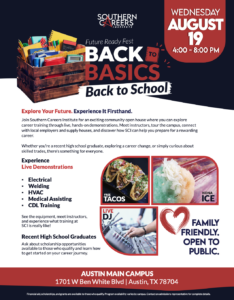
A campus tour can help turn a general program description into something more concrete. Seeing the shop, laboratory, electrical training area, or commercial driving equipment can reveal which environment feels most interesting.
Future welding students can ask how many people share each workstation, which welding processes are practiced, and how completed welds are evaluated. HVAC students can ask which systems and diagnostic tools are used. Electrical students can ask about wiring projects,panels, motors, and controls. CDL-A students can ask how range and road blocks are scheduled and which vehicles are used. Students should also ask how instructors help when someone struggles. Practical training involves mistakes, corrections, and repeated attempts. The quality of feedback can be as important as the equipment itself. Other useful questions include:
What does a normal training week look like? How much work is completed online? What happens when a laboratory or driving session is missed? Which tools or protective equipment are required? How much study is expected outside class? What support is available for mathematics, theory, diagrams, or testing preparation?
Career Services may provide résumé assistance, interview practice, and job-search guidance, but students should be cautious of any claim that a program guarantees employment. Employer expectations vary, and graduates remain responsible for meeting the requirements of the positions they pursue.
To choose a welding, HVAC, electrical, or CDL training program, begin with the work you want to learn and then compare the curriculum, training environment, length, schedule, location, costs, and admissions requirements. The right decision is the program that matches both your interests and the commitment you can realistically maintain. Contact Southern Careers Institute to tour available trade programs and explore which option fits your goals.